Complete Dirt Bike Aluminum Rims: Lightweight Design and Strength for Off-Road Performance
Lightweight Design of Complete Dirt Bike Aluminum Rims
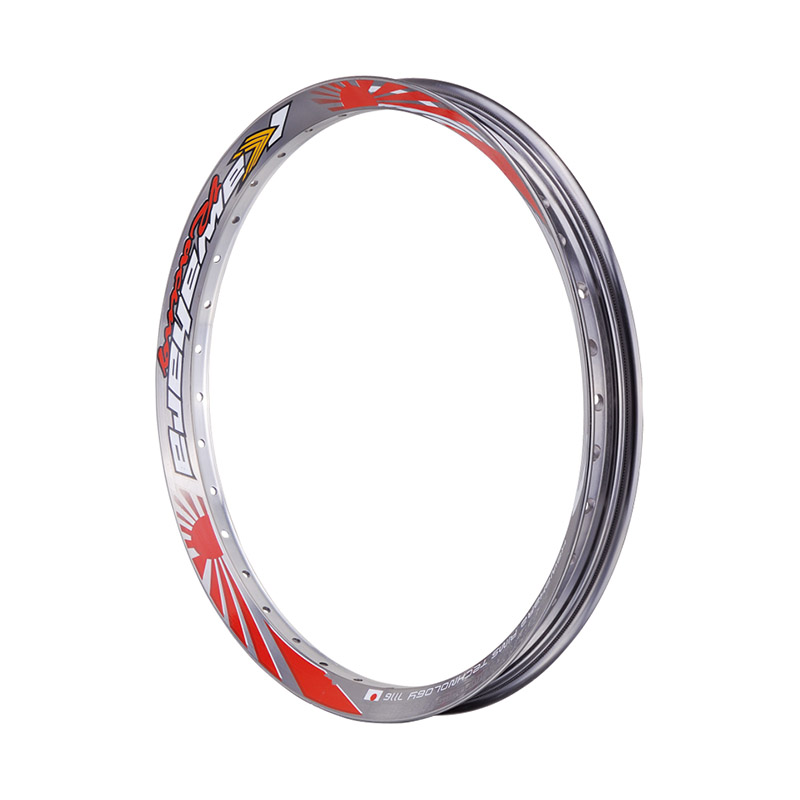
Complete dirt bike aluminum rims address this problem directly by replacing heavy steel rims with precision-formed aluminum alloys.
Unsprung weight reduction
The wheels are unsprung mass. They move up and down with every bump while the rest of the bike stays relatively still. Heavy wheels resist changing direction. The suspension works harder to control them. A complete dirt bike aluminum rim typically weighs 40–50% less than a steel rim of the same size. For a rear wheel, that means saving 1.5–2.5 pounds of rotating mass at the outer edge of the wheel. The effect on handling is disproportionate to the actual weight saved. The bike flicks into ruts more willingly. The rear wheel hooks up earlier coming out of corners because the suspension keeps the tire planted instead of fighting wheel inertia.
Acceleration and braking response
Rotational inertia matters more than static weight. A lightweight, complete dirt bike aluminum rim spins up faster when the throttle opens. The engine does not waste torque fighting the wheel's resistance to changing speed. The same principle applies to braking. Lighter rims shed speed more quickly because there is less rotating mass to slow down. On a tight motocross track with repeated acceleration and braking zones, the difference between aluminum and steel rims adds up to tenths of seconds per lap. Over a full race, those tenths become positions.
Where lightweight design shows up most clearly
- Sand and loamy tracks: A light front complete dirt bike aluminum rim floats over soft terrain instead of plowing. The bike requires less upper-body input to keep the front wheel tracking straight.
- Whoop sections: The wheel reacts to each whoop face individually rather than carrying momentum through the whole section. The bike stays settled instead of pogoing.
- Jump landings: Less rotating mass means the wheel regains traction more predictably when it touches down. The rear tire hooks up without the sudden jolt that happens with heavier wheels.
Weight comparison across rim types
An 18-inch steel rear rim for a dirt bike weighs roughly 5.5–6.5 pounds. A complete dirt bike aluminum rim in the same size ranges from 3.0–3.8 pounds, depending on the profile and alloy. The front difference is smaller because the front rims are narrower. A steel 21-inch front rim weighs about 4.0–4.8 pounds. Aluminum drops to 2.4–3.0 pounds. Add in aluminum nipples instead of brass, and another quarter pound disappears from each wheel. The total unsprung weight reduction for a set of complete dirt bike aluminum rims runs 4–6 pounds—a meaningful change that a rider feels immediately on the first lap.
Strength and Durability
Lightweight means nothing if the rim bends the first time it meets a square-edged rock. Complete dirt bike aluminum rims balance strength against weight through alloy selection, profile design, and heat treatment.
Rim profile engineering
A complete dirt bike aluminum rim is not a simple U-channel. The cross-section includes thickened sections at the bead seat, a reinforced spoke bed, and a vertical wall that resists side impacts. The profile determines how the rim distributes impact forces. Cheap rims use a constant wall thickness. The impact energy concentrates at the point of contact, causing a sharp dent. Quality rims use variable thickness. The force spreads along the rim circumference. The whole wheel flexes slightly instead of one spot collapsing.
The bead seat design also matters. A rolled bead seat (where the aluminum is folded over at the rim edge) resists pinch flats better than a machined bead seat. The rolled edge has no sharp corners that cut into the tire sidewall under hard landings. Most complete dirt bike aluminum rims from reputable manufacturers use rolled bead seats for exactly this reason.
Heat treatment and aging
Raw aluminum is soft. Extruded or roll-formed rims have little strength. Heat treatment transforms the metal. The rims go into an oven at 525–550°C, then quench in water. This solution heat treatment puts alloying elements into a solid solution. The final step is artificial aging at 175–180°C for 8–12 hours. The aging process precipitates microscopic particles that block dislocation movement in the crystal structure. The metal becomes hard without becoming brittle.
Skipping or shortening the aging cycle produces a rim that feels stiff initially but work-softens rapidly under repeated impacts. The rim develops flat spots after a few rides. Full heat treatment costs time and energy, so budget rims often cut corners here. A complete dirt bike aluminum rim from a quality supplier carries a heat treatment certification traceable to the batch.
|
Discipline
|
Recommended alloy
|
Rim profile
|
Expected rim life
|
|
Motocross (track only)
|
7075-T6
|
Shallow, stiff
|
2–4 seasons
|
|
Trail riding (intermediate rocks)
|
6061-T6
|
Medium depth
|
2–3 seasons
|
|
Hard enduro (severe rocks)
|
6061-T6 with steel inserts
|
Deep, reinforced
|
1–2 seasons
|
|
Desert racing (high-speed impacts)
|
7075-T6
|
Deep, wide
|
1 season
|
|
Vintage/retro restoration
|
6061-T6
|
Original profile
|
5+ seasons (light use)
|


 English
 Español




 浙公网安备33071802889078

